
What ChatGPT.cvom Is Best For in the Age of AI Agents
AI tools are moving beyond answering questions. They can now research topics, analyze documents, write code, work with data, and handle parts of multi-step workflows. As AI agents become more capable, simply asking ChatGPT to write an email or summarize a paragraph no longer captures what makes it useful.
If you arrived here searching for “ChatGPT.cvom,” the more important question is what ChatGPT can actually do for you today. Its value is not just in generating text. It lies in helping you understand complex problems, work through ideas, turn scattered information into something useful, and produce work that you can review and improve.
The distinction matters because ChatGPT is not only a place to ask questions. Depending on the tools available to your account, it can also support research, file analysis, data work, and more structured projects. The challenge is knowing which jobs to give it, which require more autonomous tools, and where human judgment remains essential.
Where ChatGPT Delivers the Most Value
ChatGPT is particularly useful when a task requires a mix of reasoning, explanation, synthesis, and iteration. You bring the goal and context; it helps you explore the problem, develop an approach, and improve the result.

| Use case | What ChatGPT can help you do | Where human judgment matters |
|---|---|---|
| Research and understanding | Explore a subject, compare perspectives, summarize sources, and identify unanswered questions | Checking source quality, evidence, and recency |
| Planning and decision-making | Compare options, examine trade-offs, challenge assumptions, and structure a plan | Setting priorities and making the final decision |
| Creating professional work | Develop reports, proposals, presentations, content, and working drafts | Confirming accuracy, originality, and suitability |
| Data and document analysis | Extract information, organize findings, identify patterns, and explain results from supported files | Validating calculations, context, and conclusions |
| Technical problem-solving | Explain code, troubleshoot errors, develop solutions, and test possible approaches | Reviewing code, security, and real-world behavior |
| Learning complex subjects | Break down unfamiliar ideas, work through examples, and adapt explanations to your knowledge level | Testing your understanding instead of accepting explanations passively |
These capabilities are not all available in every account or interaction. ChatGPT’s tools and limits vary by plan, settings, and feature availability. Its official capabilities overview explains the main supported categories.
The common thread is that ChatGPT becomes more useful when you give it a meaningful problem rather than a vague request. “Tell me about SEO” invites a broad explanation. “Analyze why these landing pages are losing organic traffic, separate evidence from possible causes, and prioritize the next investigations” defines a task that requires much more useful reasoning.
ChatGPT vs AI Agents and Automation Tools
AI agents have changed expectations about what software should do. Instead of only responding to instructions, agentic systems can use tools, work through multiple steps, and interact with supported environments to pursue a defined outcome. Traditional automation follows predetermined rules, while AI agents can make context-dependent choices within the limits of their tools and permissions.

ChatGPT and AI agents are not mutually exclusive categories. ChatGPT can support tool-assisted and research-intensive work, while agentic capabilities can extend AI systems into executing actions. The distinction is best understood through the kind of work you need completed.
- Use conversational ChatGPT when you need explanations, brainstorming, feedback, reasoning, or an iterative exchange to clarify a problem.
- Use research tools or deep research when you need to investigate a complicated question, synthesize multiple sources, and produce a report with references. OpenAI describes deep research as a tool for multi-step research and documented outputs.
- Use agentic tools when a task involves multiple actions across supported websites, applications, or systems and you want the tool to work through those steps toward a defined result.
- Use conventional automation when the process is predictable, repetitive, and governed by stable rules. A simple, reliable workflow often does not need an AI agent.
These categories overlap, and product capabilities continue to evolve. The useful question is not whether agents are better than ChatGPT in general. It is whether a particular task needs conversation, investigation, execution, or a combination of all three.
How to Turn ChatGPT Into a Serious Work Tool
The difference between a generic answer and useful work often comes down to how you frame the task. Instead of asking ChatGPT to produce an immediate answer, give it a clear objective, the information it needs, and a standard for judging the result.
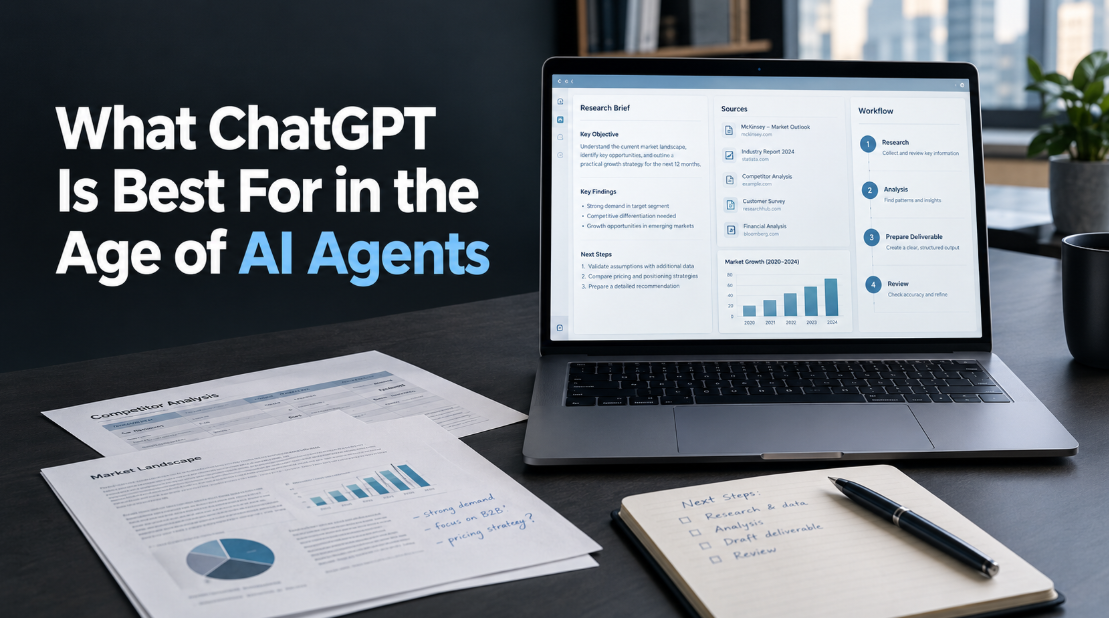
A strong workflow has four stages:
1. Define the outcome. Describe what you need to finish, not just the subject you want to discuss. For example, ask for a competitor analysis that identifies meaningful differences in positioning, audience, and offer rather than a general summary of competing businesses.
2. Provide the working context. Share relevant documents, figures, constraints, examples, or decisions already made. When the task depends on current information, use web search or another appropriate research method instead of assuming the model’s existing knowledge is up to date.
3. Request analysis before conclusions. Ask ChatGPT to separate verified facts from assumptions, explain its reasoning in a concise and reviewable way, identify missing information, and compare plausible alternatives. This makes weak evidence and uncertain conclusions easier to spot.
4. Refine the deliverable. Ask for a report, prioritized action plan, comparison table, draft, or other output you can actually use. Review the result, correct misunderstandings, and request specific changes rather than restarting the task with a vague instruction.
Consider a business owner investigating a decline in website traffic. A basic prompt might ask ChatGPT to suggest SEO improvements. A stronger task would provide traffic data, affected URLs, and relevant search performance information, then request a diagnosis that separates observed changes from possible causes and ranks the next checks by importance.
The second approach does not guarantee a correct diagnosis. It does, however, give the analysis a defined purpose and evidence to work with.
What ChatGPT Still Cannot Reliably Do on Its Own

More capable AI does not eliminate the need for verification. ChatGPT can misunderstand context, overlook relevant evidence, produce incorrect claims, or recommend actions that sound reasonable but fail in practice. Research tools can return weak sources, and agentic systems can make mistakes while interacting with external services.
Before relying on an output, check three things:
- Evidence: Are important claims supported by credible sources or supplied data?
- Execution: Has the proposed action actually been completed and verified, or has the system only described what should happen?
- Consequences: Would an error affect money, privacy, security, legal obligations, or someone’s health? If so, increase oversight and use appropriate professional or authoritative sources.
Give AI systems only the permissions and information they need for a task. Be particularly careful when tools can access private files, accounts, or external applications. A system that can take action creates different risks from one that only generates a draft.
The best results come from matching the level of autonomy to the task. Let ChatGPT help with analysis and preparation, use appropriate tools for execution, and retain human approval where mistakes would be costly.
Frequently Asked Questions
Is ChatGPT an AI model or an AI product?
ChatGPT is an AI product that provides a conversational interface to AI models and, depending on availability, additional tools. A model is the underlying technology that processes requests and generates responses; the product brings that technology together with features people can use.
Can ChatGPT connect to other applications?
Some ChatGPT experiences support connected apps and external data sources. Availability depends on the app, account plan, region, permissions, and workspace settings. Before connecting a service, review what information it can access and whether it can take actions or only retrieve information.
Do you need technical skills to use ChatGPT effectively?
No. You can begin by describing your goal in ordinary language and supplying relevant context. More advanced workflows may require familiarity with data, research methods, coding, or the tools involved, but technical knowledge is not a prerequisite for getting useful help with many tasks.
The Real Value of ChatGPT Today
The value of ChatGPT is no longer adequately described by saying it can answer questions or generate content. It can help people investigate unfamiliar problems, work with information, develop solutions, and produce useful deliverables, while supported tools can extend that work into more complex workflows.
AI agents are expanding what software can execute, but execution is only one part of solving a problem. Choosing the right objective, interpreting evidence, evaluating trade-offs, and checking the outcome remain important. ChatGPT is most useful when you treat it as a capable working partner, select the right tools for the job, and judge its output by the quality of the result rather than the confidence of the response.